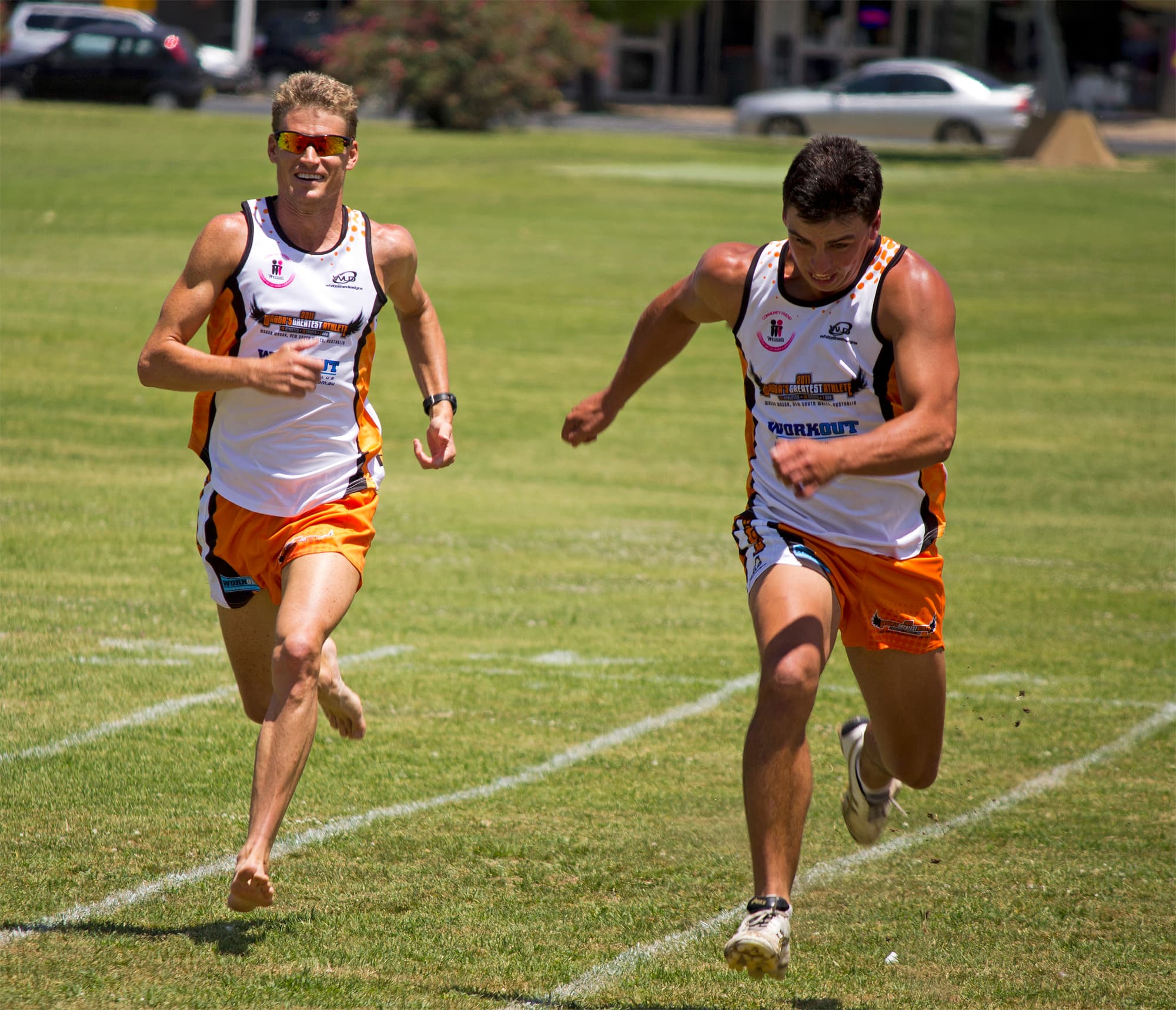
How to use your arms when running, from easy jog to all-out sprint
Your arms cancel the angular momentum of your legs and can account for up to 13% of running's metabolic cost when restricted. Here's what the biomechanics says about arm carry, hand position, and how the sprint arm differs from the jogging arm.
Most beginners think their legs do all the work. Watch a local 5K and you'll see hands clenched at the chin, elbows pinned to the ribs, shoulders riding up around the ears. The legs are turning over fine. The upper body is fighting the run the whole way.
Your arms are not passive cargo. Take them away and running gets measurably harder, your spine starts doing their job, and your easy pace turns into a tempo. The research is clear about how much arm carriage costs you when you get it wrong, what changes when you go from a steady jog to an all-out sprint, and what coaches actually mean when they tell you to "relax your hands." Below is the breakdown.
What your arms are actually doing
Each leg swing produces angular momentum around your vertical axis. Without something to cancel it out, your torso would counter-rotate every stride and your obliques would spend the run on rotation control. Your arms swing in opposition to your legs and absorb that angular momentum. The job is mechanical, not cosmetic.
How much does it cost when you take the arms away? In a 2014 study published in the Journal of Experimental Biology, Arellano and Kram had 13 recreational runners run at 3 m/s on a force-measuring treadmill under four conditions: normal arm swing, hands held behind the back, arms folded across the chest, and hands resting on top of the head. Compared to normal arm swing, net metabolic power demand rose 3% in the BACK condition, 9% in the CHEST condition, and 13% in the HEAD condition. The higher you carry your arms, the worse you breathe.
The same study showed that when arm swing is restricted, shoulder and pelvis rotation amplitudes increase to compensate. The arms aren't replacing rotation; they're managing it efficiently. Take them out and the torso does it badly.
The jogging arm
For an easy run or a steady distance pace, the goal is rhythm without effort.
- Elbow bend around 90 degrees. Not measured with a protractor. Just a comfortable, slightly-acute angle that keeps the forearm light.
- Swing from the shoulder, not the elbow. The elbow opens and closes slightly through the cycle, but the actual driver is the shoulder joint. If you feel the swing in your biceps, the elbow is doing too much.
- Hand path: hip pocket to lower chest. The hand brushes past the side of the hip on the backswing and arrives near the lower ribs on the front. It should not cross your body's centerline.
- Shoulders down. A shrugged shoulder is a tax you pay every stride. Drop them deliberately a few times per run, especially when fatigued.
This is the version you should default to for roughly 95% of your weekly mileage. It is quiet, efficient, and looks like nothing in particular.
One useful sanity check: a 2023 paper by Lang and colleagues in the journal Sports tracked 86 junior elite long-distance runners on an incremental treadmill test. The runners with greater shoulder and pelvis rotation actually had slightly lower energy costs. The takeaway: don't lock your torso. Restricting upper-body rotation in the name of "efficiency" is exactly backwards. Let the swing be natural; just don't add effort to it.
The sprint arm is a different machine
The sprint arm is not a faster version of the jogging arm. The amplitude is larger, the elbow angle changes dynamically through the stroke, and the action is more vertical than horizontal.
Elite 100m sprinters do not hold a fixed 90-degree elbow. Video analysis of world-class sprinters consistently shows the elbow closing to around 40 degrees at the top of the front swing (the hand rises near the chin or eye line), then opening to 150 to 170 degrees on the down and back swing. The cue most sprint coaches teach is "drive the elbow back," not "punch the hand forward." The hand goes where the elbow sends it.
The scapula matters too, and it matters more than most coaches realize. In a 2016 SpringerPlus study, Otsuka and colleagues used athletic tape to restrict scapular motion in 22 sprinters during the first two meters of an acceleration sprint. Sprint time over those two meters increased by 4.1% when the scapulae were taped, a larger performance hit than previous arm-only restriction studies had reported. The proposed mechanism: a restricted scapula limits backward arm extension, which limits hip extension on the same side, which limits ground force. The kinetic chain is real.
The practical translation: if you're sprinting, drive the elbow back hard, let the front hand rise to face level, and don't worry about looking calm. Sprinters do not look calm.
Hands and fists
This is the smallest part of the system and the easiest to fix.
The cardinal mistake is a tight, clenched fist. Tension at the hand propagates up the chain: forearm, biceps, shoulder, neck. By mile three of an easy run with white-knuckled fists, your traps are exhausted from a job you didn't know they were doing, and your arm swing has tightened up enough to throw off the rhythm.
The coaching cue most coaches teach is some version of "hold a potato chip." Imagine a chip between your thumb and index finger. If you crush it, you're squeezing. If you drop it, you're flailing. The right grip pressure is in between. A variation: rest the thumb gently on top of the curled index finger. The wrist stays neutral without recruiting any grip muscles.
For sprinting, the hand is more active and the fingers more decisive, but it's still not a clenched fist. Most sprint coaches teach a loose blade: fingers extended or lightly curled, thumb pointing up, no grip pressure.
📋 The form checklist worth memorizing.
Jog or easy run.
- Elbow at roughly 90 degrees, relaxed.
- Hand path from hip to lower chest. Do not cross the centerline.
- Shoulders dropped, not shrugged.
- Hands soft. Hold an imaginary potato chip.
Tempo or threshold run.
- Same shape as the jog, with a faster cadence and a slightly larger swing.
- Watch for creeping shoulder tension at mile 4 onward. Drop them on a deliberate cue.
Sprint or strides.
- Elbow closes to roughly 40 degrees at the front, opens to 150 to 170 degrees at the back.
- Drive the elbow backward. The hand goes where the elbow sends it.
- Front hand rises to chin or eye level.
- Loose blade hand. Fingers extended, no grip.
Common mistakes you can fix this week
- Arms crossing the body. The hand should never cross the sternum. When it does, the torso rotates with it and you waste energy on rotation control. Cue: "front pocket to back pocket."
- Hands at the chin during steady running. That's a sprint position. Telling your nervous system you're working harder than you are makes the run feel harder.
- Shrugged shoulders. Especially common in cold weather and at the end of long runs. Check every five minutes: shoulders away from ears, jaw soft, hands soft.
- Loose, floppy arms with no rhythm. The opposite extreme. If you can't feel the elbow drive on the backswing, you're not actually swinging from the shoulder. You're letting the arms ride.
- Mismatched cadence. Arms and legs should be locked in sync. If your arm rate is slower than your leg rate, your upper body is dragging behind. Speed the arms up and the legs follow.
Drills that actually fix this
Three drills cover most form problems without changing the run itself.
- Arm swing in place, 30 seconds. Stand still, feet planted, and swing your arms in a full running pattern. You'll feel the shoulder driving. Repeat any time the form drifts mid-run.
- Wall lean drive. Lean into a wall with arms extended overhead at a 45-degree angle, then alternate knee drives while the arms swing hard. Sprint coaches use this to teach the elbow-back action without the complexity of actually running.
- Mid-run hand cue. Halfway through any easy run, deliberately relax the hands and shoulders for ten strides. Notice what changes. Most runners report the pace feels easier even though it hasn't changed at all. That's the metabolic cost of upper-body tension showing up in real time.
TL;DR
- Your arms cost you between 3 and 13% of your metabolic budget when restricted. They are not optional. Carry them.
- For distance running: 90-degree elbow, swing from the shoulder, hand path hip to chest, soft hands.
- For sprinting: elbow angle changes dynamically (40 degrees at the front, 150 to 170 degrees at the back), shoulder drives, hand rises to chin level on the front swing.
- Hands stay soft on both. The potato-chip cue beats every other one in the wild. Tension propagates; relaxation propagates too.
- The single best fix: drop your shoulders and unclench your hands at the mile-three mark of every easy run. You will feel the pace get easier.
If you train with a group, ask a clubmate to film thirty seconds of you during an easy mile and a thirty-meter stride. Half the form problems above are invisible from the inside and obvious on video. Most active run clubs will happily film each other if you ask.
Sources and further reading
- The metabolic cost of human running: is swinging the arms worth it? (Arellano and Kram, Journal of Experimental Biology 2014)
- Scapula behavior associates with fast sprinting in first accelerated running (Otsuka, Ito, Honjo, Isaka, SpringerPlus 2016)
- Relationship between longitudinal upper body rotation and energy cost of running in junior elite long-distance runners (Lang et al., Sports 2023)